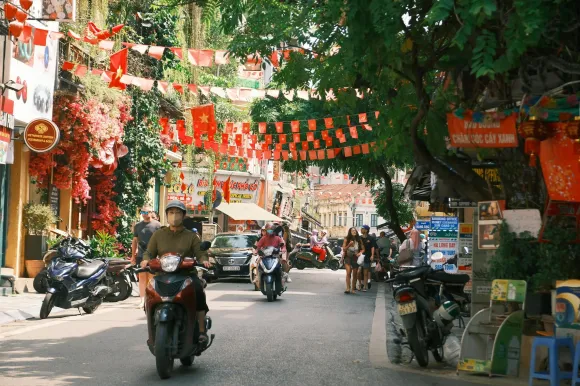
Short answer: Hanoi Train Street is a real, working railway that runs between homes and cafes in the Old Quarter area. It is worth seeing, but only if you respect the people who live there. Stay behind the painted line, never walk on the tracks for a photo, buy a drink at a cafe if you sit down, and follow the instructions of the local staff. Rules about access and cafe seating have changed over time, so check current local advice before you go and arrive early if you want a good spot.
Few places in Hanoi look as unusual on a first visit. A narrow street runs beside the tracks, plastic stools sit a few centimetres from the rails, and when the train approaches, the whole street clears in a matter of seconds. It is a striking sight, and it is also a residential neighbourhood where people cook, wash and sleep a short distance from the line.
This guide covers what Train Street is, how to find it, how to plan your visit, how to stay safe, and how to behave so that your visit does not disturb the people who live there.
The train runs on a single line through a dense part of central Hanoi. Houses and small businesses sit right beside the track, and the narrow lane next to it has become popular with visitors. Cafes have set up tables and stools along the edge, and many travelers come simply to watch the train pass at close range.
The train is not a show. It is a passenger and freight service that passes through a residential area, and it keeps to its timetable even when there are visitors on the tracks. That is why the rules around the line matter so much.
Train Street is in the Old Quarter area of Hanoi, near the Le Duan street side of the old French district. The lane is a short walk from the Old Quarter, but the entrances can be confusing, and some routes are fenced or blocked at times. Use a map app with a live location, and ask your hotel or a local cafe for the current entrance if your map takes you to a closed gate.
Ride-hailing cars and taxis can drop you on a main road nearby. Walk the last part on foot, and be prepared for narrow lanes, motorbikes and crowds on busy evenings.
The train passes a few times a day, and the timetable can change. Sources online often list different times, so do not rely on an old blog post. Ask at your hotel or at a cafe on the day, and plan to arrive at least 30 minutes before the train you want to see. Early arrival helps you secure a seat or a good standing spot behind the line.
Late afternoon and early evening are usually the busiest. A weekday visit can be quieter than a weekend. If you want photos without the crowd, aim for a time slot earlier in the day and check what the cafes are allowing at that time.
| Your goal | What to do |
|---|---|
| See the train up close | Arrive 30 minutes early, sit at a cafe that allows visitors, and stay behind the painted line. |
| Take photos | Use your phone from behind the line. Ask before photographing residents and never enter a home for a picture. |
| Avoid crowds | Go on a weekday, earlier in the day, and be ready to move quickly when the train approaches. |
The train is fast, heavy and cannot stop quickly. The safest rule is simple: stay behind the painted line at all times, and never walk, sit or stand on the rails. Pay attention to staff and cafe owners when they ask you to move, because they know the timing better than any guide.
Keep bags and phones away from the edge, especially when the train passes. Children should be held firmly by the hand. Do not lean out to film the train as it approaches. If you are wearing headphones, take them off near the tracks so you can hear the warning signals.
Train Street is a neighbourhood. Families cook meals, children play and people chat on the steps of their homes a short distance from the line. Many residents have watched visitors arrive for years, and they have strong opinions about how visitors behave.
There is no official entrance fee to watch the train from the public lane. However, if you want a seat at a cafe, it is polite and sensible to order a drink. Prices are usually modest, and the cafe owner has often made space for you on the stool. Ordering something also helps you keep a seat when the crowd gets busy.
Tour operators sometimes offer guided visits that include a drink, a short history and a photo stop. These can be useful if you want context, but they are not required.
Train Street fits well into an afternoon in the Old Quarter. Start with a walk through the old streets and a coffee nearby, then visit the Temple of Literature or Hoan Kiem Lake, and finish with dinner in the neighbourhood. If you are planning a longer stay, pair it with a day trip to Mai Chau or Ninh Binh for a change of pace.
For a practical overview of what to see around the capital and how to plan your days, the Train Street guide from CTour explains the visit in more detail, including the safety points above.
Quick checklist before you go
It is safe if you stay behind the line, listen to local staff and avoid walking on the tracks. The danger comes from ignoring the rules, especially when the train approaches.
There is no official entrance fee for the public lane. Cafes may ask you to order a drink if you sit at their tables.
Plan about 30 to 60 minutes. That gives you time to arrive early, see one or two trains and enjoy a drink without rushing.
Yes, with close supervision. Hold young children's hands at all times and keep them well behind the line.
It has been open to visitors in recent times, but access and seating rules have changed. Check current local information before your visit, because conditions can change without notice.
Plan your trip
Want Train Street as part of a wider Hanoi plan, with local context and a tailored schedule? Our team can build a private itinerary around your dates, pace and group size.
Send us your travel dates, the number of travelers and the cities you want to visit. A consultant will reply with options that work.

Vietnam Family Holiday from North to South 16 Days


Hanoi Jeep Tour to Duong Lam Ancient Village & Ba Vi National Park
Pu Luong & Mai Chau Trekking Experience – Authentic Northern Vietnam


Vietnam Family Adventure with Kids 8 Days Journey